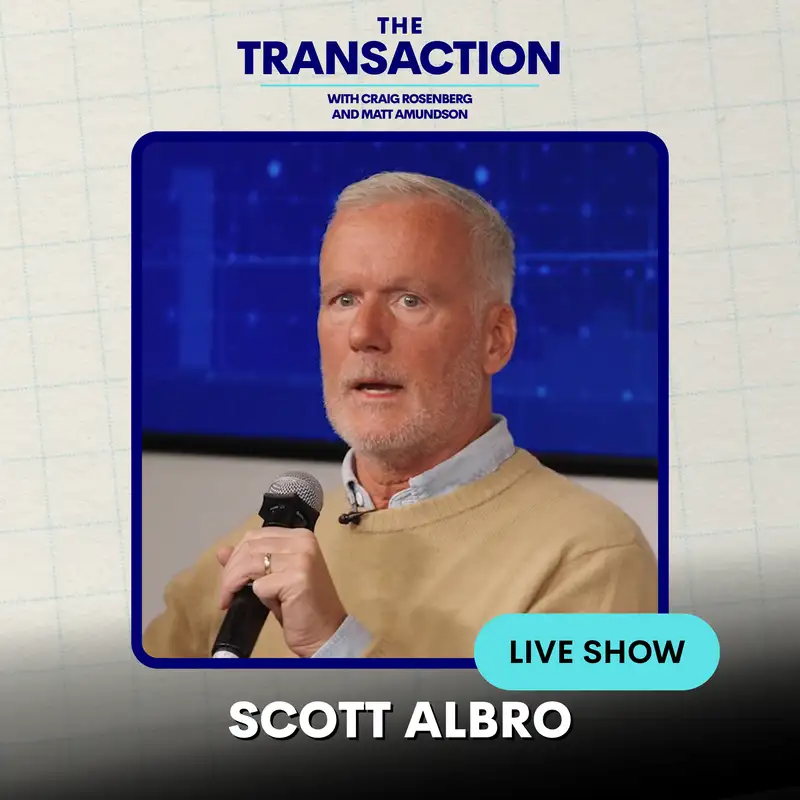
Attention is the New Moat - LIVE with Scott Albro at GTM Tailwinds - Ep 79
TT - GTM Tailwinds - Scott Albro - Full Session
===
Scott Albro: [00:00:00] The default setting for a startup is obscurity.
Scott Albro: Nobody cares, right? [00:00:05] Like it's really hard to get the market's attention. And you can keep doing the same [00:00:10] Go-To-Market things and positioning that type of stuff. Everyone else is doing that stuff, so it's not [00:00:15] likely to work. So I think about these three new things that I think every startup should be doing.
Craig Rosenberg: [00:00:20] [00:00:25] [00:00:30] [00:00:35] [00:00:40] So welcome, Scott. Thanks. You know the drill by the way. Seven [00:00:45] time transaction guests.
Matt Amundson: Seven times.
Craig Rosenberg: Yeah. So, uh, question number [00:00:50] one we want to start with is, uh, can you tell us of, of, you know, one of your [00:00:55] funniest Go-To-Market stories. Last time you did this, you made us cut it 'cause it was funny [00:01:00] and also scandalous.
Craig Rosenberg: Yeah. Uh, so, and we encourage that. But anyway, go ahead. Yeah. [00:01:05] Tell us, tell us some.
Scott Albro: Well, like most of my funny stories, this one involves [00:01:10] you, so hopefully that's okay. And, [00:01:15] and you kind of gave a nice lead into this particular story. So Craig and I, [00:01:20] um, we had built two startups together. We started working together in [00:01:25] 2007 and at our first startup, um, uh.
Scott Albro: We were, [00:01:30] we had this great run the first few years we did the, the [00:01:35] old, uh, ARR benchmark thing where you, you try and do one your first year, three [00:01:40] your second year, and then 10 your third year. And, um, by, by the way, how [00:01:45] many people know Craig personally here? A lot of you, so, so I think this [00:01:50] will track for a lot of you.
Scott Albro: Um, so, so anyway, we, we do the [00:01:55] 1, 3, 10 thing that puts us in a position to go out and raise our series C [00:02:00] uh, at, at the time in 2010, it was a big series C [00:02:05] and um, and it was led by this new investor, a very [00:02:10] well-known firm. And by a senior partner at this firm, um, that is [00:02:15] also very well, he's also very well known.
Scott Albro: He's also very, very intense. [00:02:20] And one of the most interesting moments I think, at a startup is like you, you [00:02:25] close a new round and it's really exciting. And then you have to have your first [00:02:30] board meeting with the new investors. And this is like, um, [00:02:35] those first board meetings with the new investors. It's like when you go to the dog park and all the dogs are [00:02:40] sniffing each other, and that, that's what, that's what that first board meeting [00:02:45] is typically, you know, everyone's trying to figure out like who's who, who's smart, who's [00:02:50] not, uh, what are the power dynamics in this room, that type of stuff.
Scott Albro: [00:02:55] Right? So it's a really important meeting and, um. Y you know, as a [00:03:00] founder you want to show off in that meeting, put your, make a really good first impression. Craig [00:03:05] was just at, Craig was young, inexperienced, and let's just say a [00:03:10] little rough around the edges
James Kaikis: still,
Scott Albro: but he was also really, really [00:03:15] smart. And so one of the things I wanted to do in this board meeting was basically put [00:03:20] Craig in in front of the board and I don't even remember what we had you present on.[00:03:25]
Scott Albro: But it went really well. I mean, Craig just delivered this clinic in the board meeting [00:03:30] and, um, so the board, the board meeting breaks up, everyone leaves, [00:03:35] but the new investors and I stay behind to like do our first post [00:03:40] post board meeting debrief. And we're talking about different things. And this senior partner, again, [00:03:45] this very, very intense guy, kind of pulls me aside and he goes, you know, Scott, [00:03:50] we, we got a lot to figure out here.
Scott Albro: I got a ton of questions. But one [00:03:55] thing I'm certain about is that guy Craig is the key to this [00:04:00] business and he kind of pauses and he looks around the room and he walks over to the [00:04:05] door to the boardroom and closes the door and he goes, but you know, I just gotta say the [00:04:10] user interface is highly unusual.[00:04:15]
Scott Albro: He said, and, and then he said, but we can work with that. [00:04:20] And, um, you know, I think that diagnosis holds up 15 years later. [00:04:25]
Craig Rosenberg: I remember something different, but yeah. [00:04:30]
Scott Albro: Anyway, that had nothing to do with Go-To-Market, but it is a funny story.
Matt Amundson: It
Craig Rosenberg: was a great story.
Scott Albro: I tell that [00:04:35] story. People who meet Craig for the first time, and I, I tell them that [00:04:40] story all the time.
Scott Albro: It, it is a good encapsulation of Craig. Craig, now that you have [00:04:45] a mic, anything you'd like to add?
Craig Rosenberg: Well, no, I. It's still not working. Oh. But yeah, but everyone can [00:04:50] hear this
Scott Albro: is
Craig Rosenberg: exactly what this board guy is talking about. All right, we'll, we'll [00:04:55] share
James Kaikis: Matt and I'll share.
Craig Rosenberg: Okay. So tell us, you know, you're doing a lot of work with [00:05:00] startups now.
Craig Rosenberg: Mm-hmm. And you've always been in the startup world, and so it's gonna be [00:05:05] for a lot of, you haven't heard Scott's stuff on this. It's really interesting. But. You know, tell us [00:05:10] about your three to five things that you're seeing working today in the market. And, uh, [00:05:15] we'll just start there and then we will ask questions as we go.
Scott Albro: Yeah. Great. [00:05:20] Um, yeah, I, I work with basically four to five founders CEOs [00:05:25] every year now, and as Craig mentioned earlier, I help 'em, I help 'em with a lot of different things, [00:05:30] typically falls into two. The, the founders I work with are typically early stage startups, [00:05:35] first time founders, usually technical founders.
Scott Albro: And, um, [00:05:40] by, by the, something implicit in there is like, they're usually pretty young people. And [00:05:45] um, so I help it with two areas. One is tons of Go-To-Market work and then the [00:05:50] other is what I call adult leadership. We can talk about adult leadership if you want, but on the [00:05:55] Go-To-Market side, um. The big issue I focus on now with these [00:06:00] startups is what, what I call the attention bottleneck or the attention crisis.
Scott Albro: [00:06:05] And I just have this fundamental belief that in today's market, like everything is [00:06:10] downstream of attention and, um, you know, easier than [00:06:15] ever to build products, easier than ever to create content, more [00:06:20] vendors than ever. I mean, if you, I think if you go look at like. AI sales tools or [00:06:25] assistance on G2, they're like 800 different vendors listed in.
Scott Albro: And by the way, most of [00:06:30] them aren't AI assistant tools. But
Craig Rosenberg: still it's a problem except [00:06:35] for our sponsors. Yes. Yeah. Keep going as you were. And,
Scott Albro: and then, [00:06:40] um, and, and I think we all know that, right? Like the market's really crowded and noisy, but there are a [00:06:45] couple new dynamics that make the problem even more vexing for most startups.[00:06:50]
Scott Albro: One dynamic is obviously the AI dynamic, right? Which makes building product [00:06:55] easier than ever and creating content easier than ever. But the other dynamic that I think [00:07:00] not enough people are paying attention to is yes, there's a lot more content out there now, [00:07:05] but there are also these like big, huge narratives in the market.[00:07:10]
Scott Albro: That are sort of like taking up all the oxygen in the market. And [00:07:15] so you might be a traditional SaaS vendor that tells this story or [00:07:20] narrative about, well, hey, we focus on this workflow and like we improve it by [00:07:25] 10%. Meanwhile. Founders are out there talking about data centers [00:07:30] in space or you know, batteries that can go [00:07:35] into the ocean 5,000 feet down and like will completely [00:07:40] revolutionize how we think about the ocean, right?
Scott Albro: I mean, they're just these big, huge [00:07:45] stories out there that are super hard to compete with. So anyway, I think of that as like [00:07:50] attention bottleneck or whatever you want to call it. Attention crisis. And so. And then [00:07:55] it's like, well, what do you do about that? And Craig mentioned this idea of the [00:08:00] attention engine.
Scott Albro: I don't, I, that's what I was calling it last week. I don't really like that term, so I'm not [00:08:05] calling it that anymore. I just now think of it as like three things that you need to do well as a [00:08:10] startup, right? And to get the market's attention. Remember, like the [00:08:15] default setting for a startup is obscurity.
Scott Albro: Nobody cares, right? Like [00:08:20] it's really hard to get the market's attention. And you can keep doing the same [00:08:25] Go-To-Market things and positioning that type of stuff. Everyone else is doing that stuff, so it's [00:08:30] not likely to work. So I think about these three new things that I think every startup should [00:08:35] be doing.
Scott Albro: One is you need to view your market as a network as [00:08:40] opposed to a target account list. And you need to figure out a way to [00:08:45] traverse and navigate that network in a really smart way. In most markets, there are [00:08:50] these things that I call like 10 X hubs and you need to figure out a way to [00:08:55] go in and like infect those 10 X hubs in the network.
Scott Albro: [00:09:00] And we can talk about each one of these. And then what you're trying to infect the [00:09:05] network with is a narrative, right? And we can talk about, we can [00:09:10] talk a lot about the difference between good narratives and bad narratives. [00:09:15] And the difference between a narrative and, you know, messaging or positioning or whatever [00:09:20] it's right.
Scott Albro: Um, and then the third thing I spend a lot of time on with my, with my [00:09:25] CEOs is I call 'em distribution tactics, which is, you know, like a [00:09:30] really boring term, but they're really important. And distribution tactics are [00:09:35] like the moves that you make around the network to get your narrative to [00:09:40] spread. And so just to.
Scott Albro: Give an example of like a, you know, like all the [00:09:45] founder brand stuff you see, which I think is like mostly broken, but that [00:09:50] is an example of a distribution tactic, right? Is, is founder brand. [00:09:55] So those, those are the three things that I'm really focused on right now. And I try [00:10:00] and take this approach to them, which is like, we need to be doing things that are really [00:10:05] differentiated.
Scott Albro: If you're one of those 800 AI sales assistants and you're just running [00:10:10] marketing the way that. The other 790, that's not gonna [00:10:15] work. Right. So, yeah, that's, that's how I think. Oh, and then one other thing I'd just [00:10:20] say about this attention idea is like in the early days of a startup, like [00:10:25] there's this difference between push and pull, right?
Scott Albro: And in the early days of a [00:10:30] startup, you're doing 99% push and you're doing 1% pull, [00:10:35] right? Where like the market comes to you and is [00:10:40] coincidentally pulling. The product out of your organization, right? Um, [00:10:45] most people call that product market fit. Now your objective is to [00:10:50] get, is to flip those numbers and you'll never get to 99% pull, [00:10:55] 1% push, but maybe you can get eight, you know, to like 80 20 or something like that.
Scott Albro: [00:11:00] And these companies that go zero to a hundred in a year or 18 months, they're the [00:11:05] ones who figure out how to like invert that push versus pull [00:11:10] equation. These three things are, are ways to go do that
Matt Amundson: [00:11:15] big lead in.
Scott Albro: Sorry, long lead in.
Matt Amundson: No, no, no, no. I think you set the stage [00:11:20] well. So I think.
How B2B Marketers Craft Winning Narratives That Spread Like Wildfire
---
Matt Amundson: Being a marketer, and many people in this [00:11:25] room are also marketers thinking about how do we craft that winning [00:11:30] narrative?
Matt Amundson: I think we're all, we're, we're, we're sort of nervous about, we know we need a narrative. [00:11:35] We know we need a perspective on the market. We start to think about our, our target audience as a [00:11:40] network as opposed to as target accounts. How do, how do we craft that? [00:11:45] How do, how do you think about it when you're partnering with, with some of your clients to think about a [00:11:50] narrative that, that can infect that network?
Scott Albro: Yeah. Well, I, I [00:11:55] start by thinking about like, what are the attributes of a, of a dominant winning [00:12:00] narrative? And these are just like generic attributes, right? And so a [00:12:05] few things that I believe in are like, it's gotta be big. Per the data [00:12:10] centers in space example, like you have to be able to like compete against that [00:12:15] right?
Scott Albro: Now you can do that in a narrower market, right? It [00:12:20] doesn't, it doesn't have to be data centers in space. But you know that, like that's one attribute that's [00:12:25] important. Um, it has to be differentiated. You can't be saying the same things that. [00:12:30] That everyone else is saying, you have to be able to answer the question, the, the [00:12:35] literal question.
Scott Albro: Like right now, why would my customer care [00:12:40] about this? And um, you know, typically the answer to that question [00:12:45] lies in like, you know, it's entertaining, engaging, et cetera, but it also [00:12:50] delivers value. And then, um, the other thing about your narrative is, is it has to be [00:12:55] believable, right? You have to be telling the truth.
Scott Albro: And by believable, I don't just [00:13:00] mean that in an abstract sense. I mean that like, you know, like you, your [00:13:05] demo has to like show that this narrative can become a reality. So I think about [00:13:10] those, those like attributes to start. And then the next thing I [00:13:15] do is I try and figure out. What types of narratives or stories [00:13:20] should a startup be able to tell?
Scott Albro: And I believe every startup should be able to tell [00:13:25] Three. I call 'em story types. Three story types. One is, [00:13:30] um, these are all very important. One is, um, the customer story. [00:13:35] And that typically by, by the way, I'm like staying pretty high level here, but that typically [00:13:40] revolves around two things. One is like you deeply understand what the customer is [00:13:45] going through right now.
Scott Albro: That obviously includes things like pain and [00:13:50] priorities and like day in the life, and you are able to offer up [00:13:55] ways to improve the customer's life, right? That might involve your software or whatever [00:14:00] it is, but it also needs to involve like best practices and insights and [00:14:05] data and so forth. Okay? So that's story type number one, the customer story, [00:14:10] story type number two is what I call the personal journey story.
Scott Albro: This is actually [00:14:15] your story. I do encourage startups to talk about themselves. Most people [00:14:20] discourage you from doing that, but you wanna do it in like a really personal way. Like, why did I [00:14:25] start the company? Um, what has this journey been like? Like let me [00:14:30] take you inside of this business that we're building and, and why we're building it this way and so [00:14:35] forth.
Scott Albro: And so I call that the personal journey. Then the third story type, which is [00:14:40] in today's market by far and away, the most important story type is what I call the [00:14:45] transformation story. Transformation story. There're basically three parts to it. [00:14:50] There's the status quo, which kind of looks like that customer story.
Scott Albro: There's a [00:14:55] future vision that you have that is believable, but also kind of [00:15:00] magical. If anyone's familiar with this. Literary field called Magic [00:15:05] Realism. You kind of want to think about it that way. Um. And [00:15:10] they're winners and losers in the future. You want to be able to articulate to your customer [00:15:15] why they will be a winner in the future, right?
Scott Albro: You want to do it in a really [00:15:20] specific, concrete, believable way. Like when you listen to Elon talk about the data [00:15:25] centers in space, you can see him over the last few weeks like starting to fill [00:15:30] in the details on like what these things would look like, whether, whether you think that's a good [00:15:35] idea or not.
Scott Albro: It is a good story. Then the third part of a transformation [00:15:40] story is the journey that the customer is going to go on to get from the [00:15:45] status quo to the future. And you want to be prescriptive there. You're like a [00:15:50] guide. The customer is the hero. You're like a Sherpa or a guide that helps the [00:15:55] customer get to the future.
Scott Albro: You're offering really specific guidance on how to [00:16:00] do that. You're providing these magical tools that allow the customer to get there. [00:16:05] One of those is what you sell. Right, and you just take this [00:16:10] customer on the, on this journey, you're able to articulate that again in a really [00:16:15] specific, actionable way.
Focusing Closer on Your Target Market Will Reveal The Compelling Narrative That Works For Your Buyer
---
James Kaikis: Can I ask a specific question on this? 'cause I, I really love what you're [00:16:20] talking about, but even looking at the companies that signed up, there are plenty of companies that. [00:16:25] I don't know if they can create a compelling narrative to compete with data centers in space. [00:16:30] And I think that's why I see a lot of like hyperbole out there early on with early [00:16:35] stage companies.
James Kaikis: They're putting out crazy stuff because then it, you know, you maybe can meet that like, [00:16:40] Hey, we got something really compelling here. But for your, your third option, is it, does it meet the [00:16:45] realism? So like what kind of tactical advice can you give companies that are in the room that are [00:16:50] thinking, I need to create a narrative?
James Kaikis: You know, that creative narrative that you mentioned that stands out that [00:16:55] can compete in that noise and that attention with something like space? Yeah. But [00:17:00] you know, is, is based in realism, right? Because we've talked to early stage companies who are saying, you know, the closest [00:17:05] thing to a GI you get on a demo and it's like, this is, this is nothing compelling, right?
James Kaikis: So I'm curious [00:17:10] on like how companies can bridge that gap.
Scott Albro: Yeah, totally. Well, well first of all, you don't need to [00:17:15] compete against data centers and you, you, you need to focus on your target market and [00:17:20] come up with a compel. You know, so like you, you focus on the [00:17:25] healthcare vertical, for example. You need a compelling story for [00:17:30] healthcare organizations.
Scott Albro: You know, Elon is focused on these like world transforming [00:17:35] technologies and markets, so maybe that's what you do. You're probably not at this event if that's what [00:17:40] you do, but I would, I, I encourage everyone to focus [00:17:45] on like what narrative will resonate with my specific target market. [00:17:50] And 99 times out of a hundred, that's a narrow market relative to.
Scott Albro: [00:17:55] Data centers in space or autonomous vehicles or whatever, it's right. But let [00:18:00] me give you an example of that. So my favorite narrative of the last, call it 20 years is [00:18:05] ServiceTitan. Do people know who ServiceTitan is? Right. So [00:18:10] Vertical SaaS, um, they focus on what they call the trades. And [00:18:15] you think of the trades as, you know, an HVAC repair person, or an [00:18:20] electrician, or a plumber, whatever it is, right?
Scott Albro: And, um, those [00:18:25] story types that I mentioned, they tell all three of those stories [00:18:30] at the same time and those are the best stories, right? And so if you go [00:18:35] through each one of those, they, they have this great saying, which, um. There are two [00:18:40] co-founders there and their slogan, I don't know if it still is, but their slogan used to be [00:18:45] born in the trades, built for the trades, and they would, they have a picture [00:18:50] of each, uh, founder with their dads and all [00:18:55] four of them are standing together and the reason they have a picture with their dads is because.
Scott Albro: [00:19:00] Both founders, fathers were in the trades, and so this [00:19:05] is like this deeply personal story that they're telling. And [00:19:10] because both fathers were in the trades, the founders have this incredible [00:19:15] understanding of what it's like to be the customer and the, the, [00:19:20] the. The stories that they tell about this are just incredible, right?
Scott Albro: Like one story they like to [00:19:25] tell is how, you know, one of their dads would come home, get home at like eight o'clock after [00:19:30] being out in the field, he would have to run his hands under warm water to like [00:19:35] loosen his joints up so he could sit down at the kitchen table and like send [00:19:40] out invoices. Right. I mean, that's incredible, right?
Scott Albro: So you've [00:19:45] got the personal journey, you've got the customer story, and then the transformation story [00:19:50] that they were telling or maybe still are, is like the trades are frozen in [00:19:55] time. These businesses are being run like they existed in the [00:20:00] 1970s or whatever, and that doesn't need to be the case. These are like really va by the way, if you know [00:20:05] anything about these are like.
Scott Albro: Really great businesses that were being run off of kitchen [00:20:10] tables, pen and paper. And these guys were just like, we can digitize these [00:20:15] businesses. We can modernize them. These businesses should be run like, you know, modern businesses, [00:20:20] right? That's the transformation story. And so if you think about that, that's not [00:20:25] competing.
Scott Albro: You're not competing against data you, but that is the biggest [00:20:30] story in that industry, right? And they do all three things incredibly well. [00:20:35]
Matt Amundson: There's something that's so authentic about that. A hundred percent. Specifically in that [00:20:40] example, how much,
Why & How CEOs Should Incorporate Their Own Authenticity into Their Narrative
---
Matt Amundson: when you're chatting with the CEOs that you work with, are [00:20:45] you encouraging them to bring that level of authenticity into their narrative?[00:20:50]
Scott Albro: Oh, totally. I think authenticity is, um. [00:20:55] You know, those attributes we talked about earlier, right? It's one of the most important attributes, [00:21:00] and sometimes founders ask me when I, when I tell 'em that, like they say like, [00:21:05] well, do I, do I have to have been an electrician or a plumber? [00:21:10] To start ServiceTitan and it's, that would [00:21:15] help.
Scott Albro: Right? And like, like the founders of ServiceTitan, like were [00:21:20] serendipitously sort of born into this opportunity, which does not happen with most founders. [00:21:25] But so, so then the question is like, how do you develop that? How do you craft [00:21:30] that authenticity? And you just have to become a student of the game [00:21:35] and, and you have to like immerse your, and I recommend that you start.
Scott Albro: By [00:21:40] immersing yourself in your customer's lives. Right. And I, you know, Craig and I worked [00:21:45] together for a long time. And I would say like Craig is a great example. You know, Craig is [00:21:50] now known as like this incredible Go-To-Market expert. We, our second startup, [00:21:55] which was really successful, I tell, you know, there, after you sell a business, you try and [00:22:00] distill down like, what was that business?
Scott Albro: What was really happening there? And [00:22:05] one distillation that I have of Topo is like. We were basically [00:22:10] taking all the stuff in Craig's brain and productizing it [00:22:15] and like selling it. And, but Craig wasn't born that way. He [00:22:20] acquired that knowledge, you know, over the course of, you know, at that, at that point, like a 15 [00:22:25] year career or whatever it is.
Scott Albro: And. And so, so it is just like [00:22:30] you're curious. You're spending as much time with customers as possible, and you're just developing this body of [00:22:35] knowledge that does in fact make you
James Kaikis: authentic. I'm [00:22:40] curious on where the line is. 'cause I love the authenticity play. I think that there's [00:22:45] plenty of people in this room that can log into LinkedIn and they see something, it's somewhat cringe, you know?
James Kaikis: Right. [00:22:50] It's just like crossing a line. Choose, yeah. You know, it's crossing a line. Right. So like where is the [00:22:55] line? Has the Rubicon has been crossed? Yes. So where is the lion? [00:23:00] Right? Like, how do you work with founders to find that level of authenticity, vulnerability, tell that [00:23:05] narrative and story. Without pushing it too far, right?
Scott Albro: Yeah. [00:23:10] Well, okay, so we're sort of shifting the conversation of founder brand now it feels like, which [00:23:15] is one distribution tactic that you can use to infect, infect [00:23:20] the network with your narrative. And it's a really powerful way to do it. I just, [00:23:25] um, and I'll try not to name names here, but, um, I just [00:23:30] think that, um.
Scott Albro: Most of us are approaching founder brand the [00:23:35] wrong in like this really tactical way, and we are [00:23:40] likely doing more harm than good. Mm-hmm. And, but there's no way to [00:23:45] measure the harm. There are only thumbs up buttons on [00:23:50] the social platforms. And so, um, you got [00:23:55] 5,000 impressions on that cringe slot post the other day, [00:24:00] and you got a hundred likes, let's just say 4,500 [00:24:05] people just didn't feel compelled to do anything but those other [00:24:10] 400 people out of the 5,000.
Scott Albro: They, they didn't like what you [00:24:15] did, right? Like you're, you are doing irreparable harm to your brand with this cringe [00:24:20] slot. And so I, what I tell the founders that I work with is [00:24:25] like, no, your objective with founder brand is for you to become personally [00:24:30] synonymous with the market or category that you play in.[00:24:35]
Scott Albro: And people ask me, well, what does that mean? And I give him one [00:24:40] example. I've, I've only been able to think of a few examples and the example that I like is Nick [00:24:45] Meta from Gainsight. And you know, Nick's no longer at Gainsight. Nick Nick's, [00:24:50] I've known Nick for a long time. Craig's known him for a long time and I don't even know if this was [00:24:55] something intentional that he did.
Scott Albro: We, we, you should have him as a guest at one of these events. [00:25:00] But basically Nick became personally synonymous with the customer [00:25:05] success category and. Um, it, it, it is [00:25:10] that is so much more valuable than this stuff that dominates the world of [00:25:15] founder brand today, where it's like, you know, I wrote this like, cringe post, got a hundred [00:25:20] likes.
Scott Albro: I mean, who cares? And, and [00:25:25] so the way to do it is the way that Nick did it. And, um, it's personally [00:25:30] synonymous with the category. People then ask me, well, how do you do that? And it is a high energy endeavor. Like [00:25:35] if you know Nick, you know, he is like a super high energy guy. And I [00:25:40] describe Nick when I was a venture backed founder, I would go to these events.
Scott Albro: You get [00:25:45] invited to these dinners and events every night. And every single one I went to, I saw [00:25:50] Nick, he was just everywhere all at once. And yeah, [00:25:55] maybe he was posting on LinkedIn, but he was also speaking at events. They did their own event. Right? [00:26:00] Like he had this look, you know, like he dressed a certain way so that he was [00:26:05] memorable.
Scott Albro: Right. And so, you know, if you don't know Nick, I just encourage you to go read up on him. [00:26:10] He's, he's an incredible like high energy person and I would describe [00:26:15] his founder brand strategy is as everywhere, all at once, and it [00:26:20] goes way beyond like. Posting on a certain platform, [00:26:25] it's like, no, I'm everywhere all at once.
Scott Albro: So I, I don't know how [00:26:30] else to put it. It take, it takes a lot of energy. I would say that.
Craig Rosenberg: I know I said I wasn't gonna [00:26:35] ask questions. You're allowed to. I am. Alright, good. Go. And by the way, one, we gotta have this [00:26:40] guy on more often. I feel really good about myself. There's been multiple stories about me. All [00:26:45] right.
Craig Rosenberg: Uh, take note, other speakers. All right. And then, um, uh, but
Treating Your Market as a Network of Target Accounts, Not Just a Target Account List
---
Craig Rosenberg: [00:26:50] can we just back up because you said something pretty provocative in the start, right? Which was. [00:26:55] You gotta think of your market as a network, not as a set of accounts.
Scott Albro: Yeah. [00:27:00]
Craig Rosenberg: And I think that's a big deal. And so like if we, can you talk about that for a [00:27:05] minute and well probably longer than a minute, but I think that's important to sort of [00:27:10] re-baseline us and then we can talk about the other stuff that comes out of that.
Scott Albro: Yeah, definitely. I mean, I [00:27:15] think the big idea is like you can, you should have a target account. I'm not saying you shouldn't have a [00:27:20] target account list or an ICP or whatever it is. I just think as a [00:27:25] startup, you are looking for leverage when you enter [00:27:30] a market. And there's the old school way of finding leverage, [00:27:35] um, which is like, Hey, I believe I, I have like this ICP or [00:27:40] target account list or whatever, and that yields like these, um.
Scott Albro: [00:27:45] What I would kind of think of as like funnel or pipeline improvements, right? Like my [00:27:50] conversion rate goes up because of that or my ACV increases because I'm [00:27:55] focused on the right accounts. Totally cool. You should do that. But the other thing you can [00:28:00] do is you can find strategic leverage. By thinking of [00:28:05] your market as a network.
Scott Albro: And what I would do is I would identify who [00:28:10] your target customer is, and then identify the nodes in the network [00:28:15] that connect with the customer, right? And some [00:28:20] of these nodes are these 10 x hubs or nodes or whatever, whatever you wanna call 'em. [00:28:25] And if you can infect one of those nodes or multiple nodes in the [00:28:30] market.
Scott Albro: With your narrative, you just get like, [00:28:35] talk about turning, push into pull. That's a great way to turn, push into pull. [00:28:40] So again, people are like, well, what does that mean? And, and um, [00:28:45] and you know, there, they're real examples of this, right? One of 'em is actually a [00:28:50] Go-To-Market tech example. So everyone's familiar with Clay.
Scott Albro: Um. [00:28:55] One of the reasons everyone's familiar with Clay is Clay in the early days [00:29:00] basically said, Hey, we're gonna go infect this hub, which is in our [00:29:05] network, which is cold outbound email agencies. [00:29:10] Which, you know, if you, if they had told me that, however, you know, three, five years ago when they start, I [00:29:15] would've said, that's a really bad idea.
Scott Albro: But it was actually a really good idea. And the reason it [00:29:20] was a good idea is called outbound email agencies are power users. [00:29:25] They are connected to lots of now [00:29:30] end clay customers and have a ton of influence over those people. [00:29:35] Um, they are willing to push the envelope on how a product gets [00:29:40] used, and as a result of that, they tend to see higher ROI than say, you know, the [00:29:45] marketing department at a Fortune 500 company would, and they're loud as [00:29:50] hell, like they will talk about you if it works.
Scott Albro: And [00:29:55] so that's an example of one of these 10 X hubs and, and one [00:30:00] of the primary reasons Clay has been so successful. Another more recent [00:30:05] example is granola. So how many people here, if, [00:30:10] if I had come to you and said, Hey, I wanna start a, a 12 months ago, I wanna start a new note [00:30:15] taking app. How many people would've said I, I'll write a check for that.
Scott Albro: Literally no one [00:30:20] right. But Granola had this ama, they viewed their market as a [00:30:25] network, and the first hub that they went after in their network was the [00:30:30] VC community. Now they have this calling card, it's, they're a really good product team over there. [00:30:35] And so they were able to get meetings with VCs, but they targeted VCs because VCs [00:30:40] have lots of meetings and they have lots of meetings with founders.
Scott Albro: [00:30:45] And that was Granola's next customer that they wanted to win. Oh, VCs are [00:30:50] allowed to, particularly on Twitter X, right, where a lot of founders are hanging out, [00:30:55] everyone's trying to figure out like, what are the VCs thinking? Well, like a year ago or whenever it [00:31:00] was, you just see granola popping up everywhere and I'm asking people like, what [00:31:05] is what?
Scott Albro: How is this different than it kind of didn't matter. They just [00:31:10] ended up dominating the VC founder discourse on Twitter. And [00:31:15] again, the VCs were a 10 x hub for them. Founders were also a 10 [00:31:20] x hub for them because that took them into startups. Right. And [00:31:25] so that was like a really well executed your market is is a network [00:31:30] type strategy.
Scott Albro: I think they're raising around right now. Maybe it's closed billion and a half [00:31:35] dollar, uh uh, yeah. Billion $1.5 billion valuation right now on a [00:31:40] note taking app. That was like five years late to the market. And it was [00:31:45] just, we're gonna go lock up these season founders. All the cool, what Craig and I used to call the [00:31:50] cool kids at Topo.
Scott Albro: And um, and we'll go from there. So, and I [00:31:55] guarantee you there is a version of this in your market, right? It could be [00:32:00] consultants, influencers, early, I mean, crossing the chasm if people still [00:32:05] remember that is like fundamentally I view my market as a network, right?
Matt Amundson: I [00:32:10] think those were both great examples.
Creating Systems for Founders and CEOs to Build Attention Around Your Brand Narrative
---
Matt Amundson: Thinking through like one of the things I think is [00:32:15] challenging as people think about pulling all these ingredients together is [00:32:20] most founders are thinking about building their systems. Whether that's their system for [00:32:25] how they develop products, whether that's their system for how they're thinking about Go-To-Market.
Matt Amundson: [00:32:30] These examples? Like how much, when you work with the CEOs, are you thinking about [00:32:35] building a system for this or are you thinking about like, Hey, this is a [00:32:40] work in progress and we're gonna develop this together, and as we find that either [00:32:45] message market fit, or we find the right hubs for our business, then we're creating [00:32:50] systems or.
Matt Amundson: As you bring them into this world, is there like kind of a system list that you're [00:32:55] bringing them through and probably don't have time to go through it if that's the case, but like I wonder [00:33:00] about that because I think so many people are like, well, if you're in Go-To-Market, you're like building a [00:33:05] funnel.
Matt Amundson: If you're building product, you're doing agile. As you think about this [00:33:10] component, does it have a system or is that still to be defined? [00:33:15] Or is it unique?
Scott Albro: Yeah. Um, I think it depends upon which one of the [00:33:20] three things mm-hmm. We're talking about. So like narrative, in my opinion, you don't really need a [00:33:25] system for that.
Scott Albro: I don't, that might be an interesting area to explore, but you know, [00:33:30] like you're, you, you, you can and should your change your [00:33:35] strategic narrative and like optimize it, but you probably, you probably don't need a system for that, I don't [00:33:40] think. Viewing your market as a network? I think, I mean, I don't, I [00:33:45] don't, I haven't built a tool, but like if someone's built a tool for that or, or is building i'd, I'd [00:33:50] write a check for that.
Scott Albro: Um, I think that's a pretty good idea. Like, hey, you know, [00:33:55] not a static target account list, but something like really shows network [00:34:00] connections in my target market I think would be really, really interesting. [00:34:05] So I don't have a system for that with the CEOs that I work with. You know, it's more like, hey, let's just [00:34:10] map this thing out in like a Google sheet or some something.
Scott Albro: Right?
Matt Amundson: Yeah. The, the and I, and I don't mean [00:34:15] like software, I just mean like what is, what is the like order of operations Yeah. To [00:34:20] bring this to life. Yeah.
Scott Albro: Well, you know, start with your target market, [00:34:25] obviously, right? Like, um, and understand what the networks are that you care about. And [00:34:30] in particular, these kind of 10 X hubs.
Scott Albro: Build a narrative that will resonate with them. [00:34:35] I typically recommend that founders do both of those things to get, you know, like you don't have to [00:34:40] finish one to do two, you want to do 'em both alongside, and then on the [00:34:45] distribution tactics, that is where a system is really valuable, which is like, [00:34:50] think of distribution tactics as like just continuous [00:34:55] experimentation around like, here's how I'm gonna infect the network with my narrative.[00:35:00]
Scott Albro: Like lovable does a really good job of this, right? They are. They [00:35:05] are constantly running these growth bets and experiment all the time, and they're [00:35:10] rapid fire. They see what works. They double down on the ones that work. They [00:35:15] jettison the ones that don't, and that, that requires real like [00:35:20] system.
James Kaikis: Level type thinking.
James Kaikis: Fun fact is we're gonna be talking about [00:35:25] Lovable later today with carry loose sessions, so great. Love that you brought that up. Scott. This has [00:35:30] been incredible. Good news is we are recording this session. I saw a lot of people taking notes. How can people [00:35:35] follow along? How can they engage with you on this content?
James Kaikis: How can they learn more? Well, the [00:35:40] funny thing about me is like I talk about all
Scott Albro: this stuff, like, I'm like this advanced go and like I [00:35:45] don't have a website or, or I was talking to your guy yesterday, he is like, can you send me [00:35:50] content? I'm like, I don't have any content, so I don't know. Connect with me on LinkedIn.
Scott Albro: Send, [00:35:55] send me an email. My email is, you know, Scott Albro at gmail. If, if you want to connect with me [00:36:00] and, um, and uh, yeah, connect with me on LinkedIn. Sounds good. [00:36:05] Thanks so much. [00:36:10] [00:36:15] [00:36:20] [00:36:25] [00:36:30] [00:36:35] [00:36:40] [00:36:45]
Creators and Guests